When Business Fails, Does the Director Pay ?
For decades, the specter of criminal liability has cast a long shadow over the boardrooms of Indonesian State-Owned Enterprises (SOEs). The persistent fear that a calculated business loss could be construed as a financial loss to the state has historically forced corporate leaders into a hyper-conservative stance, inadvertently stifling innovation and strategic agility in an increasingly competitive global market.
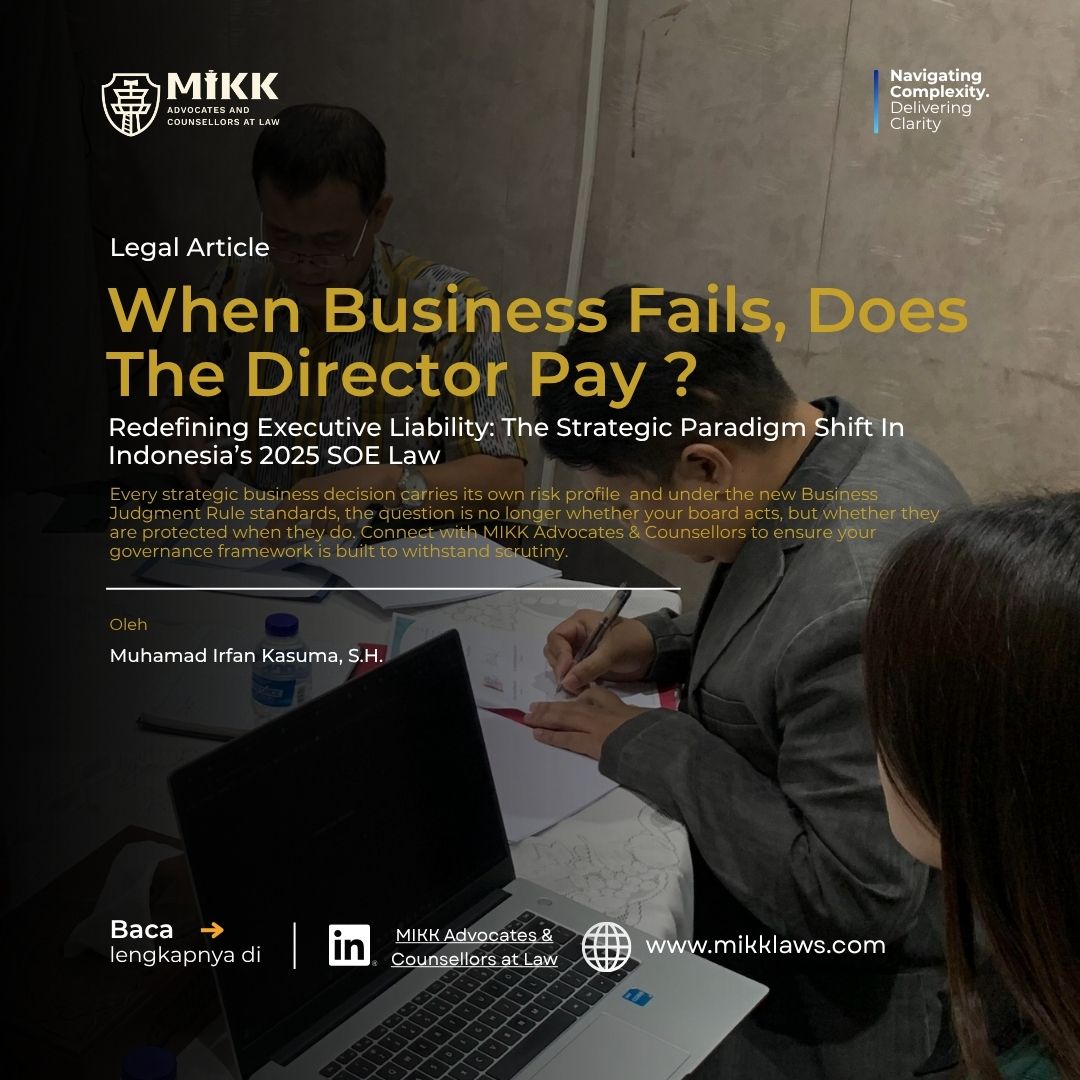
Redefining Executive Liability: The Strategic Paradigm Shift in Indonesia’s 2025 SOE Law
Executive Briefing by: Muhamad Irfan Kasuma, S.H., CPLA, Managing Partner, MIKK Advocates & Counsellors
For decades, the specter of criminal liability has cast a long shadow over the boardrooms of Indonesian State-Owned Enterprises (SOEs). The persistent fear that a calculated business loss could be construed as a financial loss to the state has historically forced corporate leaders into a hyper-conservative stance, inadvertently stifling innovation and strategic agility in an increasingly competitive global market.
The enactment of Law No. 1 of 2025 on the Third Amendment of the SOE Law marks a monumental turning point in Indonesia’s corporate governance landscape. By decisively fortifying the Business Judgment Rule (BJR) and explicitly segregating SOE assets from direct state finances, this revised legal framework liberates corporate executives from the immediate threat of criminalization over good-faith business decisions. It fundamentally shifts the accountability mechanism from a rigid “government judgment rule” to a modern, corporate-law-based structure.
For directors, commissioners, and policymakers, assuming that the operational landscape remains unchanged is a critical oversight. The new regulation not only redefines the boundaries of state financial losses but also alters the jurisdiction of the Supreme Audit Agency (BPK), paving the way for a more dynamic, private-sector-aligned operational autonomy. However, this newfound freedom is inextricably linked to rigorous adherence to the principles of prudence, transparency, and good corporate governance.
In this doctrinal analysis, we dissect the core structural changes brought by the 2025 SOE Law. We examine the critical legal line between state and corporate losses, the redefined parameters of executive protection, and what these mean for the future of state-enterprise competitiveness.
Every strategic business decision carries a unique risk profile. To discuss the practical implications of this legal reform on your enterprise’s governance structure, or to ensure your board’s decision-making frameworks are fully insulated under the new Business Judgment Rule standards, please contact MIKK Advocates & Counsellors for a high-level consultation.

Artikel ini hanya berisi informasi umum dan bukan merupakan nasihat hukum. Hubungi kami untuk nasihat sesuai kondisi Anda.